A mobile marketplace connecting El Bierzo farmers directly with urban consumers, making local seasonal produce accessible year-round while supporting small-scale agriculture.
ROLE
Solo Brand + Product Designer
TOOLS
Figma
Adobe Creative Cloud
Claude
WHAT I DESIGNED
Complete visual identity and brand system
Custom category illustrations
App icon
Consumer-side mobile app (iOS)
Design system (components, patterns)
Marketing materials
THE QUICK STORY
The Problem
El Bierzo residents who want fresh local products can only access farmers markets 3 days per week during working hours, when most people can't attend. Meanwhile, the region's 2,400+ small farmers receive only 18-25% of final retail value despite producing high-quality seasonal products. Local seasonal abundance goes unsold while consumers unknowingly buy imported alternatives at supermarkets, and there's no trusted platform connecting them.
My Approach
Trust Through Real Evidence
I noticed living in El Bierzo that trust is critical—people worry about scams and don't want to waste time on unreliable sources. You need to know what you're getting is real.
Research indicated without verified sourcing, consumers default to supermarkets with known brands rather than risk buying from unknown local producers online.
I decided every producer shows verified profiles with real farm photos (no AI-generated images), exact farm location on map, production methods transparently listed, and customer reviews from actual neighbors. Trust isn't built by saying "local quality products"—it's built by showing Miguel's face, his farm location, his free-range chickens, and reviews from people who've bought from him.
I noticed people need to understand seasonality if they want fresh farm products—tomatoes aren't available year-round, cherries have specific harvest windows. But most people don't know when things are in season.
Analyzing existing platforms revealed supermarkets hide seasonality (everything appears available through imports), while farmers markets assume knowledge ("everyone knows tomatoes are summer").
I decided rather than hiding unavailable products or creating educational content nobody reads, I'd integrate seasonal context at decision moments: "Cherries available June-July. Sign up for notification when harvest begins!" This builds anticipation for seasonal products rather than frustration at unavailability, teaching through context instead of curriculum.
I noticed consumers and farmers have fundamentally different needs, contexts, and technical comfort levels. Urbanites expect modern discovery and fast checkout. Traditional farmers need simplified order management without complexity.
Research indicated successful two-sided marketplaces (Etsy, Airbnb) serve both sides equally—optimizing for consumer convenience while adding complexity for producers fails.
I decided to create distinct optimized interfaces: consumers get category-first navigation matching meal planning behavior (browse by Frutas y Verduras, not by farm), while farmers get simplified order management focused on what they need most—tracking orders, managing inventory, coordinating delivery. Both sides get exactly what they need without compromise.
The Solution
Home - Category-First Discovery
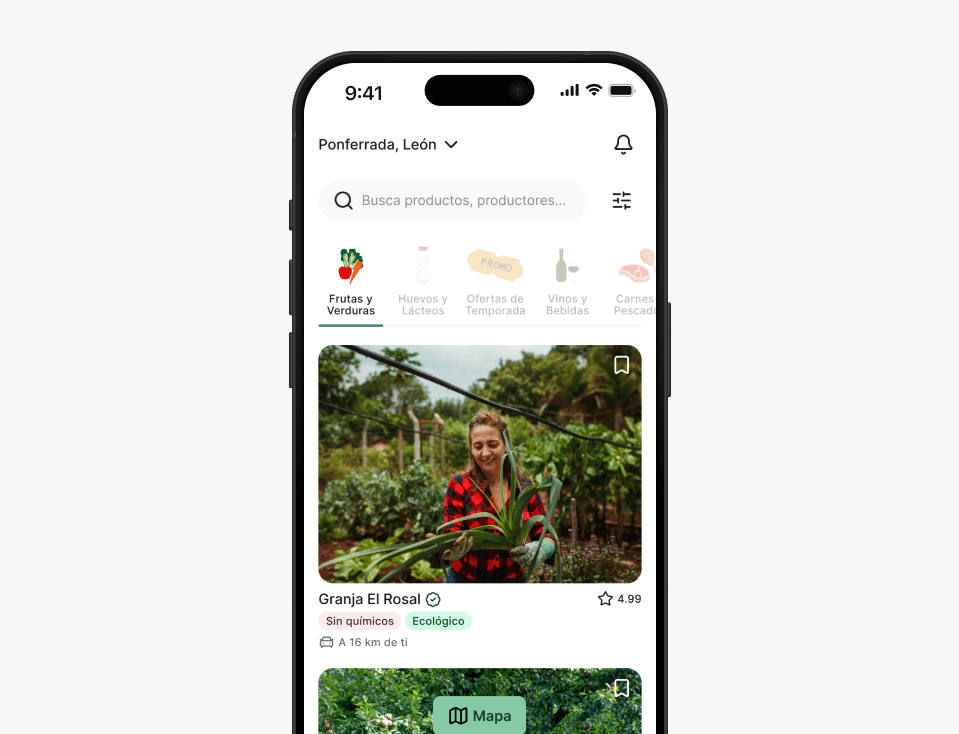
Home screen establishes mission immediately: "Del campo a tu mesa. Sin intermediarios." Custom category illustrations (Frutas y Verduras, Carnes y Pescados, Huevos y Lácteos) match meal planning behavior—browse by ingredient type, not by farm. Location selector shows local focus (Quilós, Cacabelos). Featured seasonal offers and curated packs highlight what's fresh now. This creates familiar grocery shopping patterns while connecting directly to local farms.
Location-Based Discovery
Location based discovery prioritizes producers within 30km radius shown on interactive map. Category filter (Huevos y Lácteos) refines results. Real farm photos, production method badges (Ecológico, Artesanal, Cosecha propia), and distance indicators help users find authentic local products. Map and list views offer flexible discovery—visual exploration or quick scanning.
Producer Profile - Verified Trust
Producer profiles showcase farm credentials with real farm photos, verification badges, and transparent production methods. "Ver Mapa" shows exact farm location. Three key trust indicators (Cosecha propia, Sin químicos, ratings) build confidence. Delivery methods listed clearly. Products organized by category with badges on each item. Users explore full farm catalog or add directly to cart.
Brand Graphics
Raíz needed to feel alive and natural, celebrating agricultural abundance without appearing rustic or dated. The brand bridges traditional food culture with modern convenience, appealing to urban professionals while resonating with farmers who value authenticity.
What I designed:
Logo & App Icon — Rooted in agricultural heritage while feeling modern and accessible. The visual language celebrates regional food traditions without nostalgia, making local food feel fresh and contemporary.
Color System — Natural greens and earth tones that feel authentic to agricultural environments. Warm, approachable palette avoiding the cold perfection of commercial food photography. Colors communicate freshness, trust, and regional authenticity.
Custom Illustrations — Rather than stock photography (sterile and generic), I created custom produce illustrations for each category (vegetables, eggs, milk, meat, olive oil). These provide visual warmth and category recognition while celebrating the character of real farm products—imperfect, seasonal, alive.
Typography & Components — Clean, readable sans-serif balancing modern expectations with approachable warmth. Large touch targets for varied technical comfort levels. High contrast for outdoor market use. Everything designed for real-world contexts—farmers at markets, consumers planning meals.
What I Learned
01
Trust requires evidence, not persuasion
I initially thought building trust meant writing compelling copy about quality and local sourcing. But I learned trust comes from verifiable evidence—Miguel's face, his farm location on map, his production methods, reviews from neighbors. Show, don't tell.
02
Give context, not education
The design challenge wasn't creating educational content about when tomatoes grow—it was integrating seasonal awareness at decision moments. "Tomatoes available June-September" teaches through context when it matters, not through curriculum users ignore.
03
Opposing needs require separate solutions
I assumed I'd need to compromise between consumer expectations (sleek, fast) and farmer capabilities (simple, minimal). But good dual-sided design creates distinct optimized experiences for each user type. Don't split the difference—serve both fully.
Thanks for reading
If this case study resonates with how you think about design: research-driven, user-centered, and focused on real impact. I'd love to talk about opportunities with your team.