Pulse

Pulse

Self-Initiated Conceptual Project

Self-Initiated Conceptual Project

Mobile App

Mobile App

Project Overview

Project Overview

Pulse Community transforms fragmented outdoor trip planning into confident adventure through trust-based community intelligence. When 45 million Americans waste 2+ hours researching a single hike across disconnected platforms, only to still feel uncertain. I saw an opportunity to design the platform I wished existed. I designed an iOS app consolidating trail discovery, real-time conditions, and community expertise into one trusted source. The platform reduces planning time by 85% while addressing a gap no competitor solved: connecting outdoor adventure with measurable conservation impact.

Role

Solo UX/UI Designer

Tools

Figma, Adobe Illustrator, Claude

Skills Demonstrated

  • User Research & Synthesis

  • Information Architecture

  • Mobile-First Interaction Design

  • Visual Design & Brand Identity

  • Design System

  • Gamification & Engagement Design

  • Community Platform Strategy

The Challenge

The Challenge

Outdoor enthusiasts waste 2+ hours planning a single hike across fragmented platforms: AllTrails for trails, Instagram for photos, Reddit forums for conditions and yet still lack confidence because they can't assess who to trust. When 30+ million new outdoor enthusiasts emerged post-pandemic, existing platforms couldn't bridge the gap between "I want to hike" and "I'm confident to go", costing people transformative experiences and increasing environmental impact on overcrowded trails.

Across all platforms, users struggle to assess credibility. No platform provides clear expertise indicators answering: "Can I trust this person's advice for my skill level?"

Meanwhile, 73% of millennials prioritize environmental values, but no platform connected outdoor adventure with measurable conservation impact. Existing platforms either ignored sustainability (AllTrails, Strava) or focused purely on activism without adventure features (Patagonia Action Works).

Outdoor enthusiasts waste 2+ hours planning a single hike across fragmented platforms: AllTrails for trails, Instagram for photos, Reddit forums for conditions and yet still lack confidence because they can't assess who to trust. When 30+ million new outdoor enthusiasts emerged post-pandemic, existing platforms couldn't bridge the gap between "I want to hike" and "I'm confident to go", costing people transformative experiences and increasing environmental impact on overcrowded trails.

Across all platforms, users struggle to assess credibility. No platform provides clear expertise indicators answering: "Can I trust this person's advice for my skill level?"

Meanwhile, 73% of millennials prioritize environmental values, but no platform connected outdoor adventure with measurable conservation impact. Existing platforms either ignored sustainability (AllTrails, Strava) or focused purely on activism without adventure features (Patagonia Action Works).

The Solution

The Solution

I designed Pulse Community as a mobile-first iOS platform that consolidates outdoor adventure planning with trust-based community intelligence through three core innovations:

Credible Community Intelligence: Visible expertise indicators (experience level badges, activity timelines, and helpful vote counts) help users instantly assess advice credibility. This transforms anonymous advice into verified expert guidance.

Dual Achievement System: Users earn badges for both adventure accomplishments (trail types, distances, elevations completed) and conservation actions (cleanups participated in, sustainable choices made, impact measured). This makes environmental responsibility feel empowering rather than guilt-inducing, naturally aligning community behavior with outdoor values.

Story-Driven Learning: Post-trip flows capture valuable trail conditions when users are most motivated to share. Detailed trip reports with gear recommendations and lessons learned scale expert knowledge efficiently—one experienced hiker's story helps hundreds of beginners through authentic, contextualized advice.

I designed Pulse Community as a mobile-first iOS platform that consolidates outdoor adventure planning with trust-based community intelligence through three core innovations:

Credible Community Intelligence: Visible expertise indicators (experience level badges, activity timelines, and helpful vote counts) help users instantly assess advice credibility. This transforms anonymous advice into verified expert guidance.

Dual Achievement System: Users earn badges for both adventure accomplishments (trail types, distances, elevations completed) and conservation actions (cleanups participated in, sustainable choices made, impact measured). This makes environmental responsibility feel empowering rather than guilt-inducing, naturally aligning community behavior with outdoor values.

Story-Driven Learning: Post-trip flows capture valuable trail conditions when users are most motivated to share. Detailed trip reports with gear recommendations and lessons learned scale expert knowledge efficiently—one experienced hiker's story helps hundreds of beginners through authentic, contextualized advice.

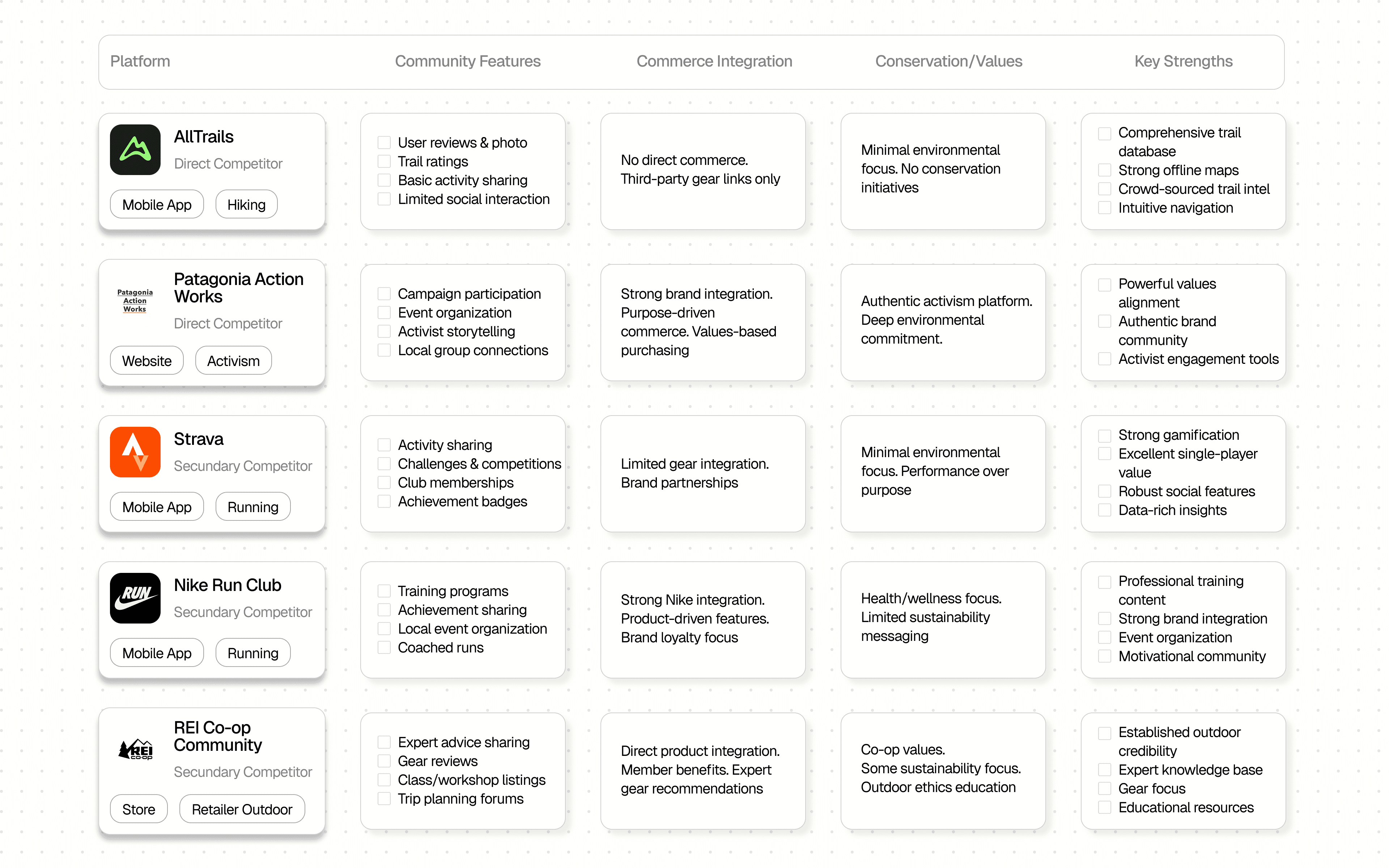
Competitive Landscape

Strategic Takeaways:

  1. Values-Driven Community Gap: Only Patagonia Action Works successfully combines environmental values with community engagement, but completely lacks outdoor activity tracking. AllTrails has comprehensive data with minimal environmental focus. No platform bridges this divide.

  2. Trust Crisis in Outdoor Advice: Across all platforms, users struggle to assess credibility. AllTrails treats all reviews equally. Strava focuses on performance metrics. Reddit forums are anonymous. No platform provides clear expertise indicators answering: "Can I trust this person's advice for my skill level?"

  1. Gamification Works, But Needs Purpose: Strava proves gamification drives exceptional engagement, but its performance-obsessed culture alienates casual enthusiasts. Nike Run Club shows brand community works but feels corporate. No platform combines meaningful gamification with authentic values and inclusive community.

  2. Commerce Integration Feels Forced: AllTrails has no commerce (missed revenue). REI feels too commercial with constant product pushing. Strava's partnerships feel disconnected from user needs. No platform serves users first, sells second through authentic gear integration.

  3. Single-Player Value is Non-Negotiable: Strava validates that platforms must provide value when used alone—community enhances but doesn't replace core utility. Outdoor adventurers want more meaning than just data tracking (Strava) or basic trail info (AllTrails).

The Opportunity: Build the first platform that consolidates trust-based trail discovery, community mentorship, and conservation impact into one experience, serving both anxious beginners and experienced advocates.

  1. Values-Driven Community Gap: Only Patagonia Action Works successfully combines environmental values with community engagement, but completely lacks outdoor activity tracking. AllTrails has comprehensive data with minimal environmental focus. No platform bridges this divide.

  2. Trust Crisis in Outdoor Advice: Across all platforms, users struggle to assess credibility. AllTrails treats all reviews equally. Strava focuses on performance metrics. Reddit forums are anonymous. No platform provides clear expertise indicators answering: "Can I trust this person's advice for my skill level?"

  1. Gamification Works, But Needs Purpose: Strava proves gamification drives exceptional engagement, but its performance-obsessed culture alienates casual enthusiasts. Nike Run Club shows brand community works but feels corporate. No platform combines meaningful gamification with authentic values and inclusive community.

  2. Commerce Integration Feels Forced: AllTrails has no commerce (missed revenue). REI feels too commercial with constant product pushing. Strava's partnerships feel disconnected from user needs. No platform serves users first, sells second through authentic gear integration.

  3. Single-Player Value is Non-Negotiable: Strava validates that platforms must provide value when used alone—community enhances but doesn't replace core utility. Outdoor adventurers want more meaning than just data tracking (Strava) or basic trail info (AllTrails).

The Opportunity: Build the first platform that consolidates trust-based trail discovery, community mentorship, and conservation impact into one experience, serving both anxious beginners and experienced advocates.

Problem Statement

Problem Statement

Eco-conscious outdoor enthusiasts are experiencing fragmented trip planning, lack of trustworthy recommendations, and limited meaningful community connections that prevent them from confidently exploring nature while making positive environmental impact.

This problem impacts outdoor industry customer acquisition costs and brand loyalty because current platforms don't align outdoor adventure with environmental values— forcing customers to seek community validation elsewhere instead of becoming brand advocates.

Information Architecture
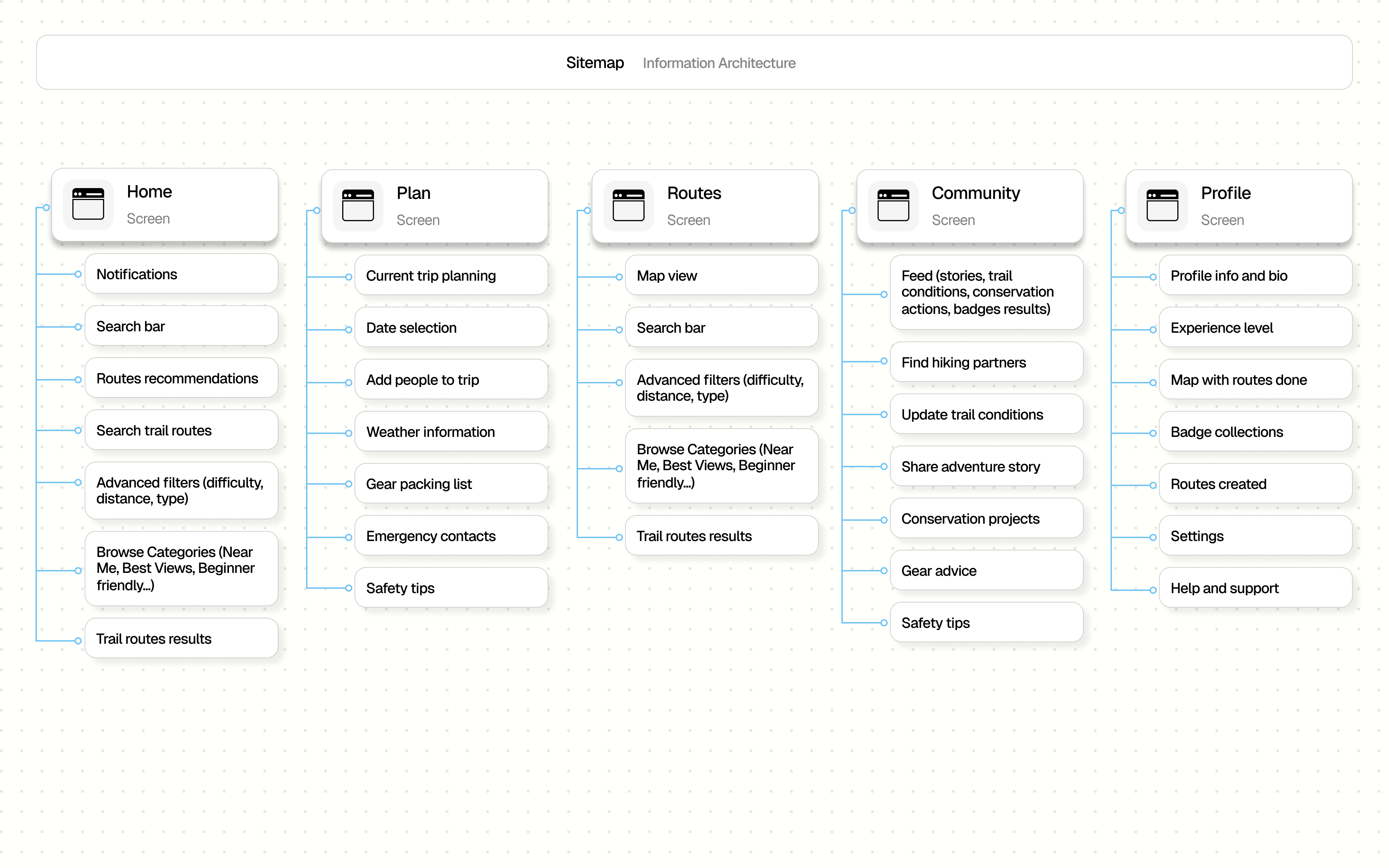
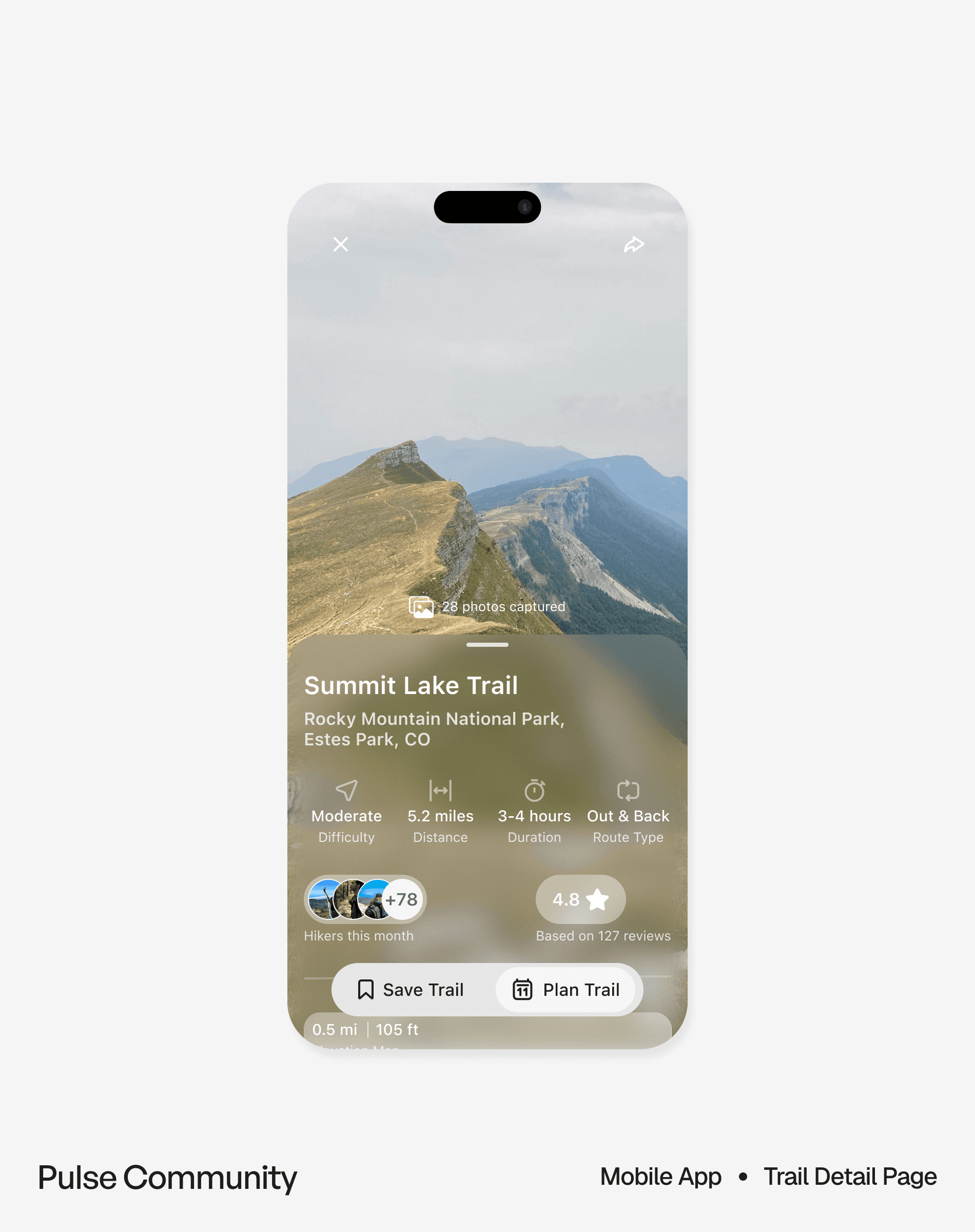
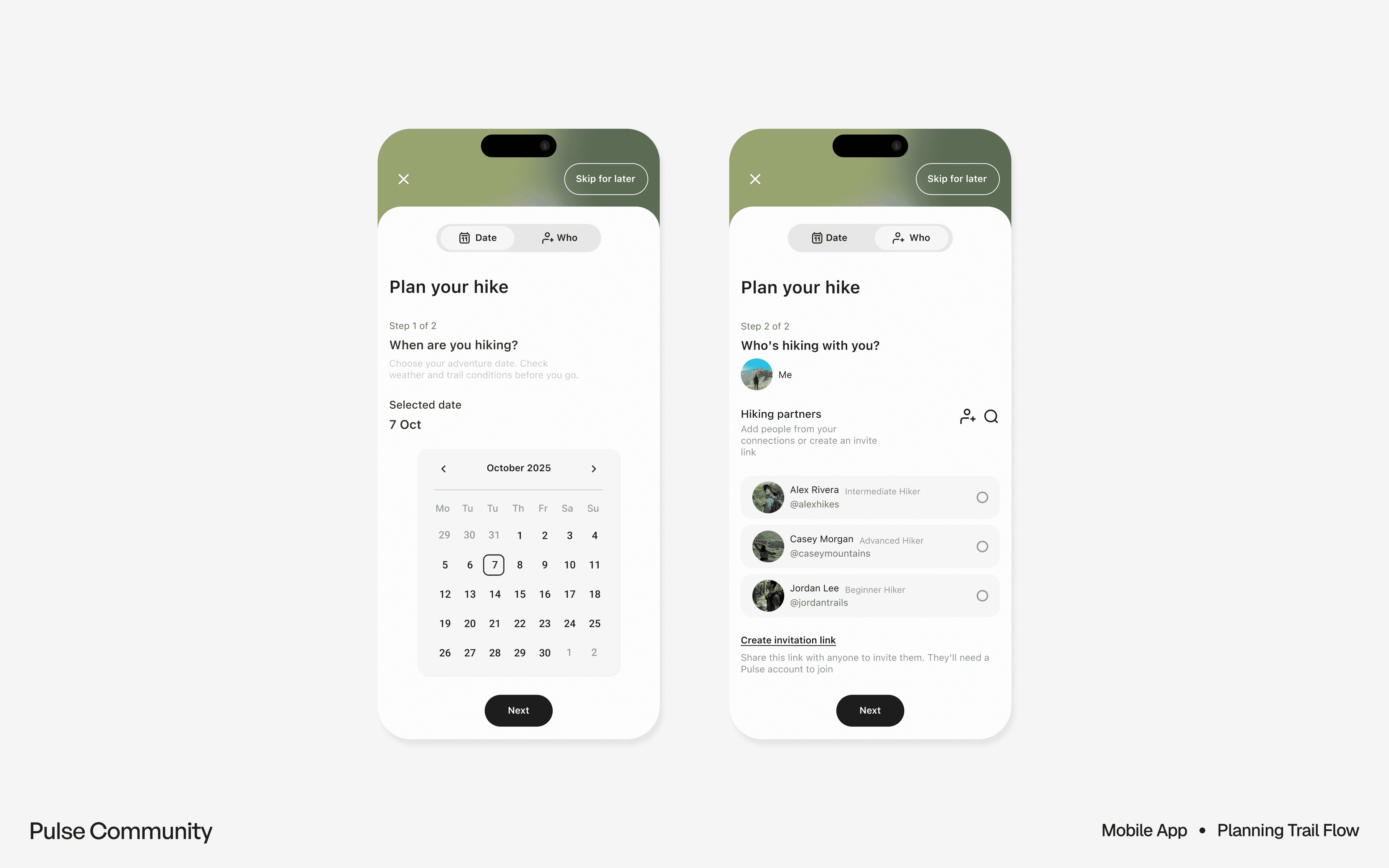
I structured Pulse around five core user needs discovered in research: discover trails (Routes), plan adventures (Plan), engage with community (Community), track progress (Profile), and get inspired (Home). The IA goes 3 levels deep maximum to maintain mobile usability, with clear separation between "finding trails" (exploration) and "planning trips" (logistics) to mirror natural user mental models.

My biggest challenge was serving both anxious beginner needing simplicity and experienced mentor wanting comprehensive tools. Early wireframes tried separate modes—"beginner mode" and "expert mode"—but testing indicated this felt limiting and artificial.

The solution: three-tier information architecture. Hero section with essentials above fold gives beginners confidence from first screen. Quick facts second screen provides additional context. Tabbed deep-dive on-demand serves experts without overwhelming novices. Beginners get confident decisions from first two screens. Experts tap tabs for depth when needed.

I structured Pulse around five core user needs discovered in research: discover trails (Routes), plan adventures (Plan), engage with community (Community), track progress (Profile), and get inspired (Home). The IA goes 3 levels deep maximum to maintain mobile usability, with clear separation between "finding trails" (exploration) and "planning trips" (logistics) to mirror natural user mental models.

My biggest challenge was serving both anxious beginner needing simplicity and experienced mentor wanting comprehensive tools. Early wireframes tried separate modes—"beginner mode" and "expert mode"—but testing indicated this felt limiting and artificial.

The solution: three-tier information architecture. Hero section with essentials above fold gives beginners confidence from first screen. Quick facts second screen provides additional context. Tabbed deep-dive on-demand serves experts without overwhelming novices. Beginners get confident decisions from first two screens. Experts tap tabs for depth when needed.

Visual Design System

Pulse needed a visual language that felt authentic and natural, not corporate or overly polished, while maintaining the credibility and professionalism required for safety-critical outdoor planning. The visual system balances approachability with expertise.

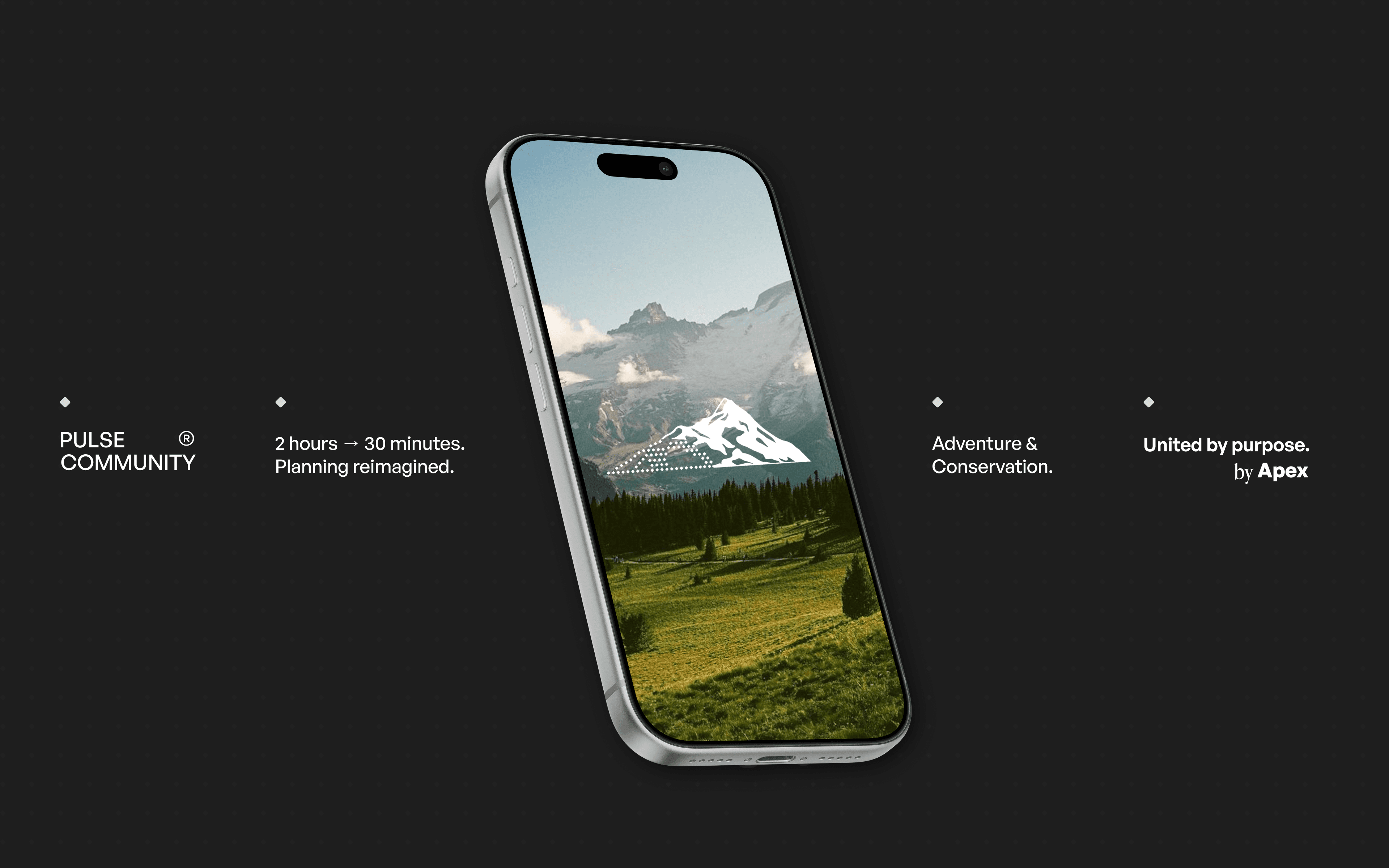
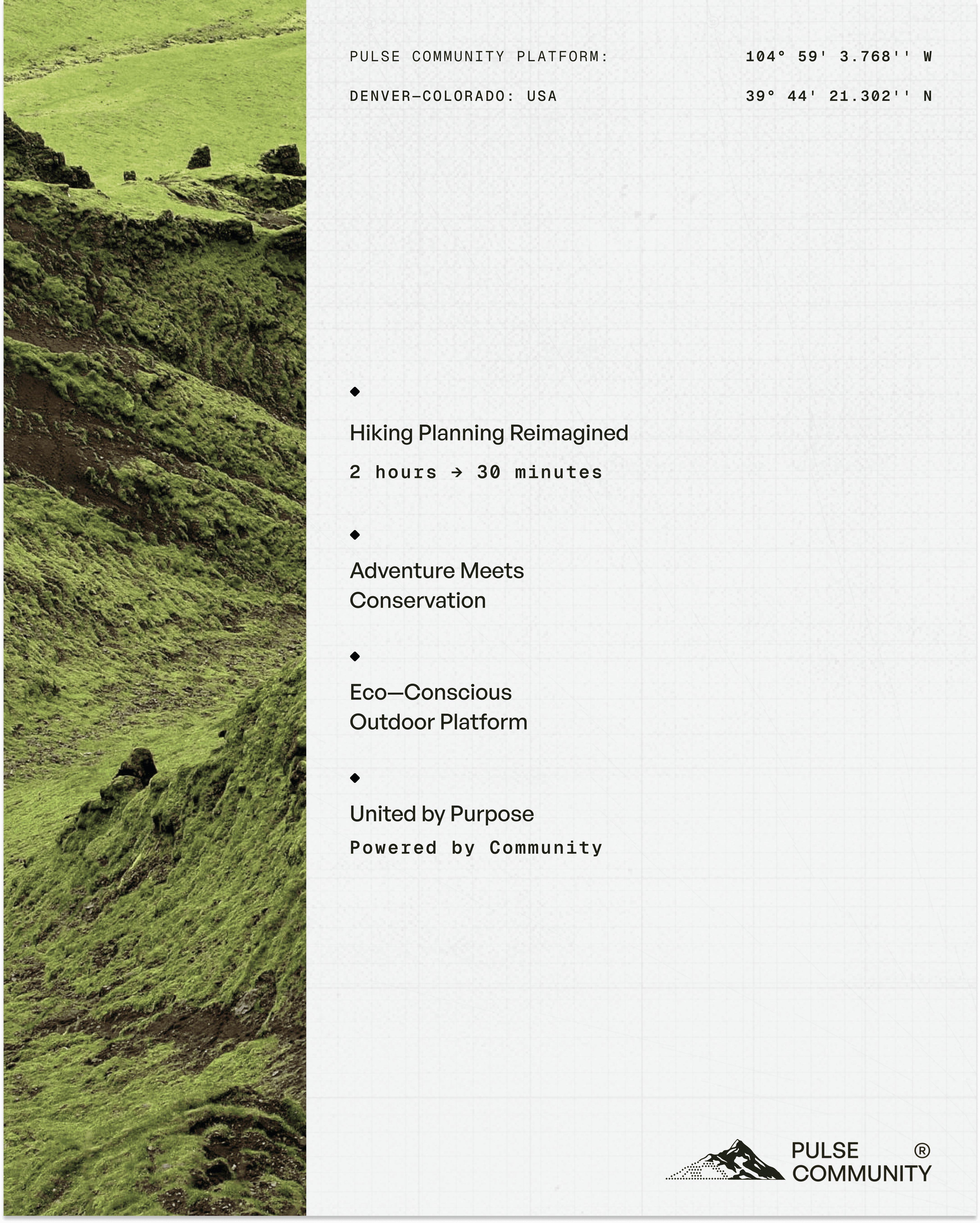
The logo uses a stylized mountain silhouette with dotted trail pattern representing the journey from beginner to expert. The geometric shape communicates stability and trust, critical for outdoor safety decisions. The dotted "pulse" pattern suggests both heartbeat (connection to nature) and trail path (adventure journey). This balances approachability for beginners with credibility for experienced users.
Wireframe Evolution
High Fidelity Designs

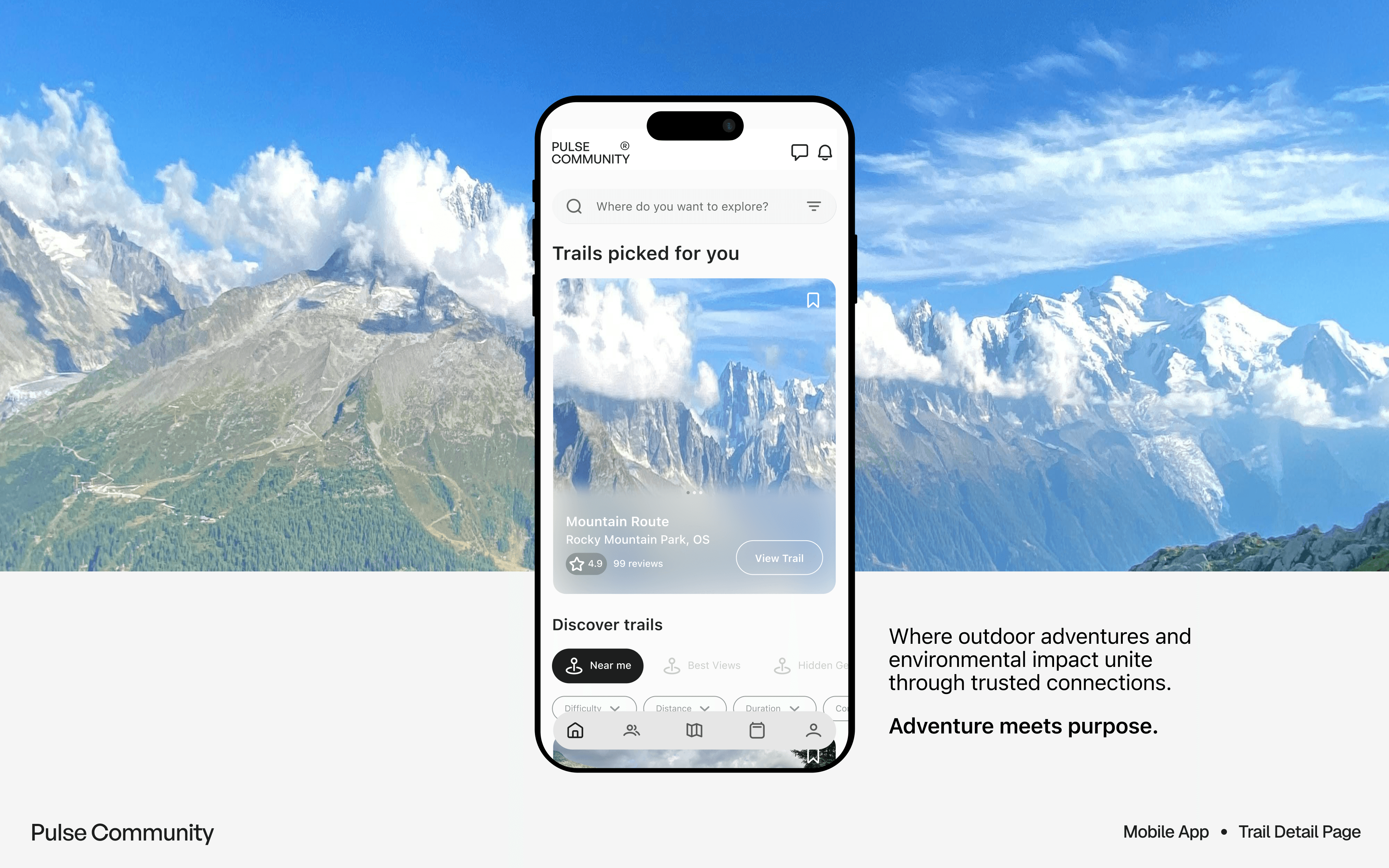
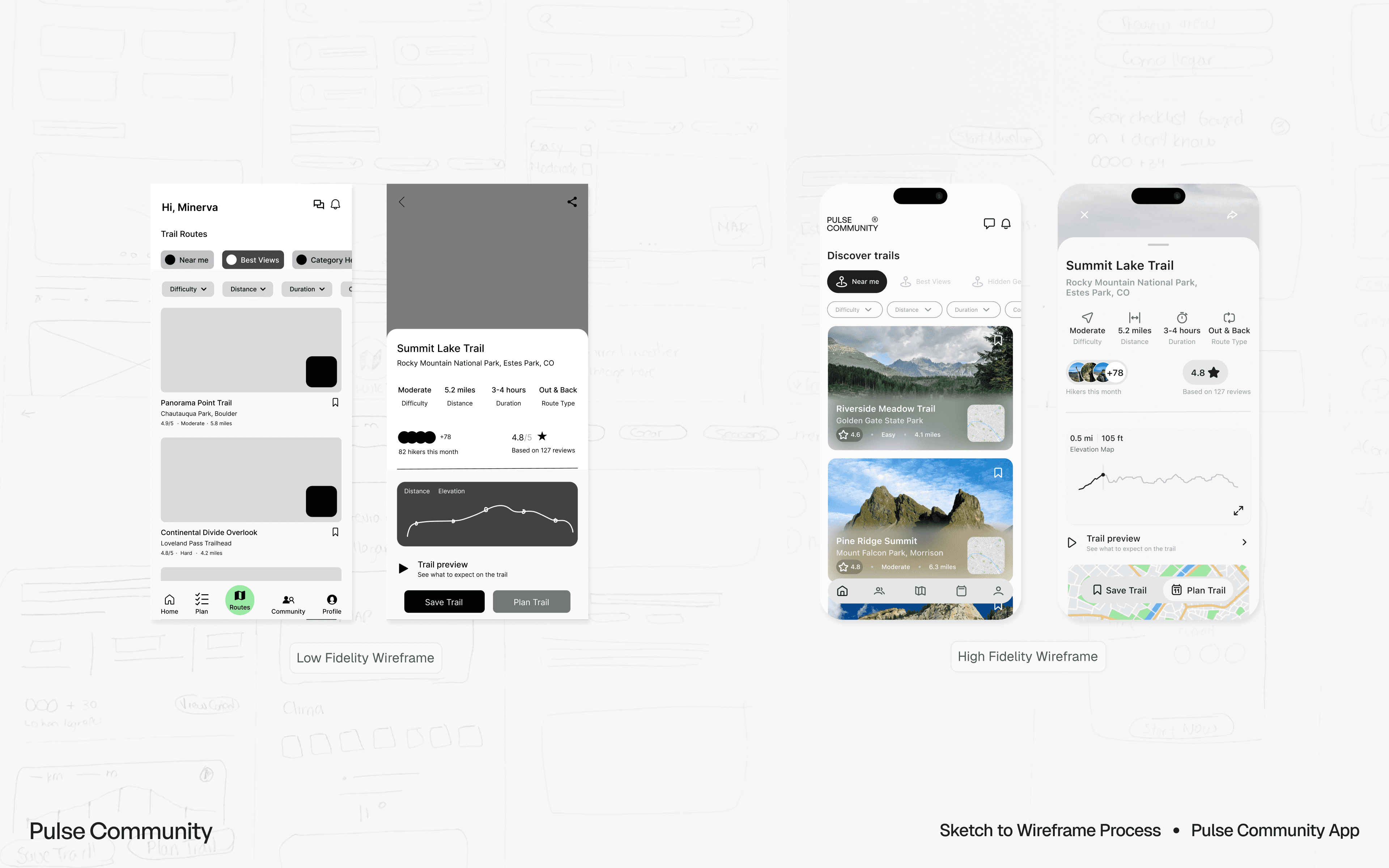
Trail discovery interface with trust-filtered recommendations and clear visual hierarchy. Cards show aggregate community rating, recent activity, and difficulty at a glance. Search and filter controls optimized for thumb reach at bottom of screen. Users can quickly scan options without endless scrolling through undifferentiated lists.
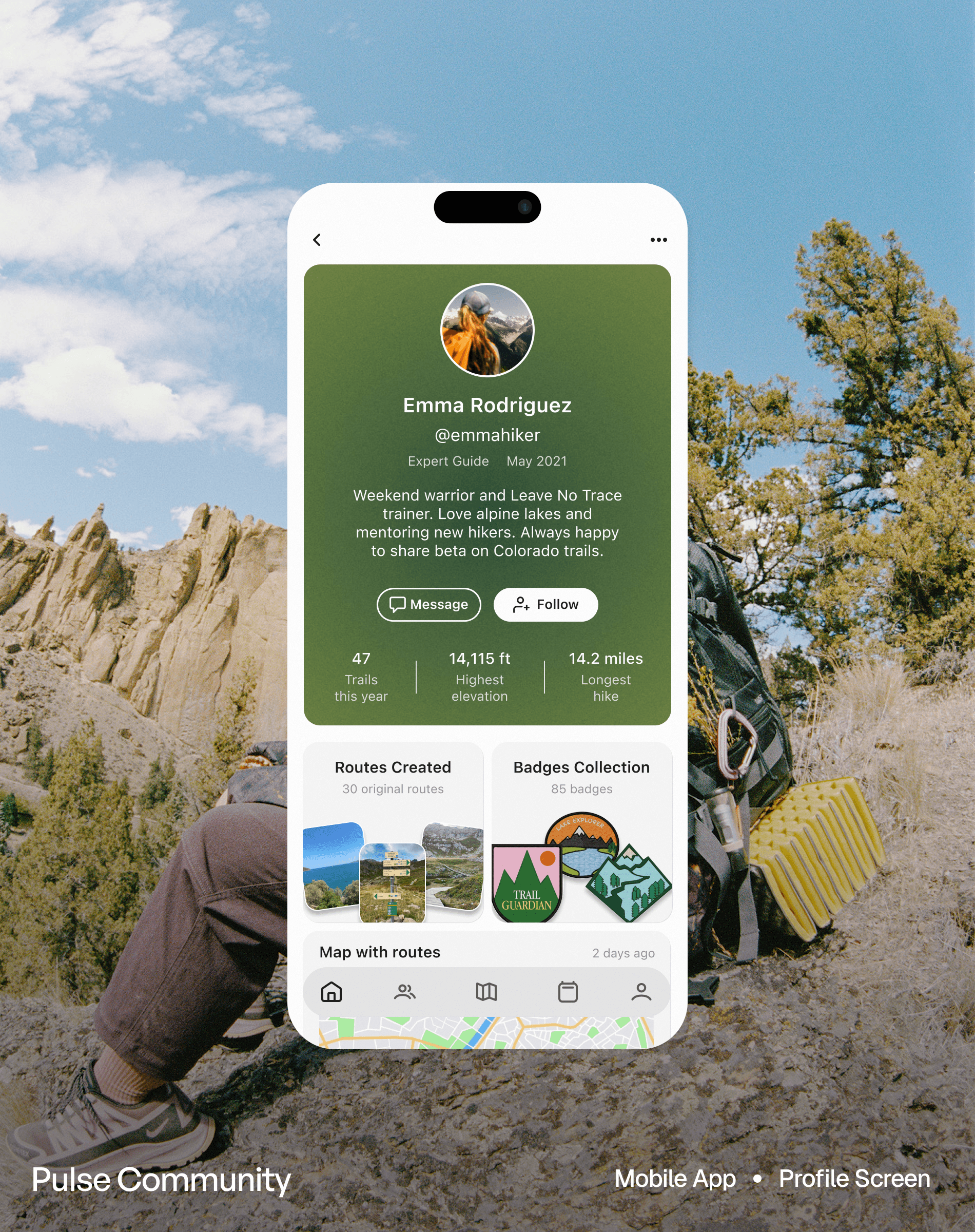
Profile screen demonstrating dual achievement system—adventure badges (trail types, distances completed, elevations gained) balanced with conservation badges (cleanups participated, sustainable choices made, impact measured). Environmental impact is visible and celebratory, not guilt-inducing. Community standing based on helpful contributions and mentorship, not just activity volume.
What I Learned

What I Learned

This project fundamentally shaped how I approach UX design, teaching me lessons I'll carry into every future project.

  1. Information Architecture Is About Timing, Not Just Organization: When I struggled with where to place weather information, I initially thought: "users need all weather data to make decisions." But through designing the flows, I realized users need different information at different moments.

    This taught me that information architecture isn't just about organizing content, it's about understanding when users need information and in what context. Good IA matches the same data complexity to the user journey stage.

  2. Design for Two Audiences Requires Progressive Disclosure, Not Separate Experiences: My biggest challenge was serving the anxious beginner needing simplicity and the experienced mentor wanting comprehensive tools.

    The solution: progressive disclosure with essential information above fold and detailed data accessible through tabs, taught me that good design respects diverse needs through thoughtful hierarchy rather than segregation.

  3. Gamification Works When It Serves Purpose Beyond Engagement: I was initially skeptical about badges and achievement systems, worried they'd feel gimmicky for serious outdoor enthusiasts. But researching Strava's success with dual achievement (personal goals + community challenges) taught me that gamification works when it reinforces authentic behaviors rather than manufacturing artificial goals.

    Gamification should amplify desired behaviors that already benefit users and community, not create addictive loops that serve only engagement metrics. When designed ethically, gamification can motivate positive actions like mentorship and conservation participation.

  4. Trust Can't Be Assumed, It Must Be Designed: Research revealed users waste hours cross-referencing sources because they can't assess credibility. This taught me that trust isn't something users bring to platforms, it's something platforms must systematically build into design.

    Visible credibility indicators (experience level badges, recent activity, helpful votes) aren't decorative, they're functional elements that solve a real user problem: "Can I trust this person's advice for my skill level?" By making trust transparent and verifiable throughout the interface, Pulse transforms anonymous advice into credible guidance from verified experts.


This project fundamentally shaped how I approach UX design, teaching me lessons I'll carry into every future project.

  1. Information Architecture Is About Timing, Not Just Organization: When I struggled with where to place weather information, I initially thought: "users need all weather data to make decisions." But through designing the flows, I realized users need different information at different moments.

    This taught me that information architecture isn't just about organizing content, it's about understanding when users need information and in what context. Good IA matches the same data complexity to the user journey stage.

  2. Design for Two Audiences Requires Progressive Disclosure, Not Separate Experiences: My biggest challenge was serving the anxious beginner needing simplicity and the experienced mentor wanting comprehensive tools.

    The solution: progressive disclosure with essential information above fold and detailed data accessible through tabs, taught me that good design respects diverse needs through thoughtful hierarchy rather than segregation.

  3. Gamification Works When It Serves Purpose Beyond Engagement: I was initially skeptical about badges and achievement systems, worried they'd feel gimmicky for serious outdoor enthusiasts. But researching Strava's success with dual achievement (personal goals + community challenges) taught me that gamification works when it reinforces authentic behaviors rather than manufacturing artificial goals.

    Gamification should amplify desired behaviors that already benefit users and community, not create addictive loops that serve only engagement metrics. When designed ethically, gamification can motivate positive actions like mentorship and conservation participation.

  4. Trust Can't Be Assumed, It Must Be Designed: Research revealed users waste hours cross-referencing sources because they can't assess credibility. This taught me that trust isn't something users bring to platforms, it's something platforms must systematically build into design.

    Visible credibility indicators (experience level badges, recent activity, helpful votes) aren't decorative, they're functional elements that solve a real user problem: "Can I trust this person's advice for my skill level?" By making trust transparent and verifiable throughout the interface, Pulse transforms anonymous advice into credible guidance from verified experts.


Available for new opportunities

Available for new opportunities

Available for new opportunities

Thanks for reading

If this case study resonates with how you think about design: research-driven, user-centered, and focused on real impact. I'd love to talk about opportunities with your team.